❝ 1. FROM TOKYO SHADOWS TO AMERICAN LIGHT ❞
Before New York ever whispered her name,
Rei Kawakubo had already changed what fashion could mean.
Her brand, Comme des Garcons, wasn’t born to impress —
it was born to interrogate.
When the label finally crossed the Pacific in the 1980s,
America wasn’t ready — but it was curious.
New York’s fashion elite, who worshipped polish and glamour,
suddenly met something raw, anti-beautiful, and devastatingly intelligent.
“My clothes are not for those who want to look pretty,”
Rei Kawakubo once said.
“They are for those who want to question everything.”
✧ 2. LANDING IN NEW YORK — A CULTURAL COLLISION
In 1983, Comme des Garcons’ New York arrival felt more like an art invasion.
Minimal boutiques replaced glossy windows.
Ripped, blackened fabrics replaced sequins and silk.
Fashion editors called it “Japanese weirdness.”
Artists called it revolution.
The avant-garde spirit that thrived in Tokyo’s Aoyama district
found an echo in SoHo’s art scene —
home to Jean-Michel Basquiat, Keith Haring, and the post-punk underground.
Comme des Garcons fit perfectly —
an alien language America secretly wanted to learn.
⚡ 3. AMERICAN STREET ENERGY MEETS JAPANESE INTELLECT
The U.S. didn’t just import the brand —
it translated it.
On the streets of New York, Los Angeles, and Chicago,
Comme des Garçons’ oversized black silhouettes
became statements of independence, not despair.
Skaters, art students, musicians —
they all wore Rei’s rebellion like armor.
The same deconstruction that once puzzled Paris
now powered the energy of American streetwear.
By the early 2000s, you could find Comme des Garcons PLAY hearts
flashing from hoodies and sneakers on every corner of SoHo.
From underground fashion kids to Hollywood stylists,
the message was clear:
You didn’t wear Comme — you believed in it.
✴︎ 4. PLAY: THE HEART OF ACCESSIBLE REBELLION
2002 marked a turning point.
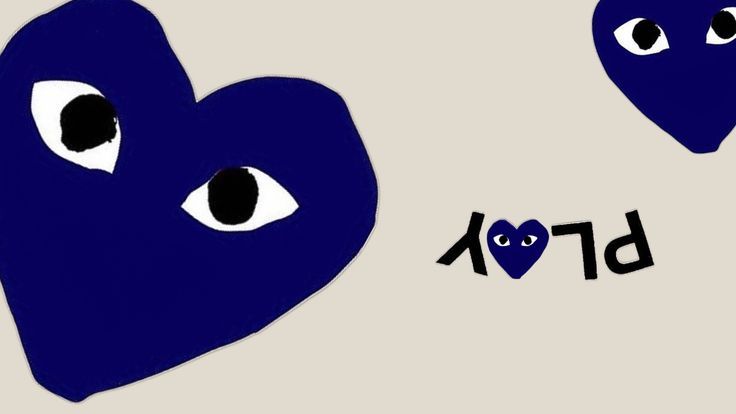
Rei Kawakubo launched Comme des Garcons PLAY,
a minimalist line that spoke softly — yet carried her DNA.
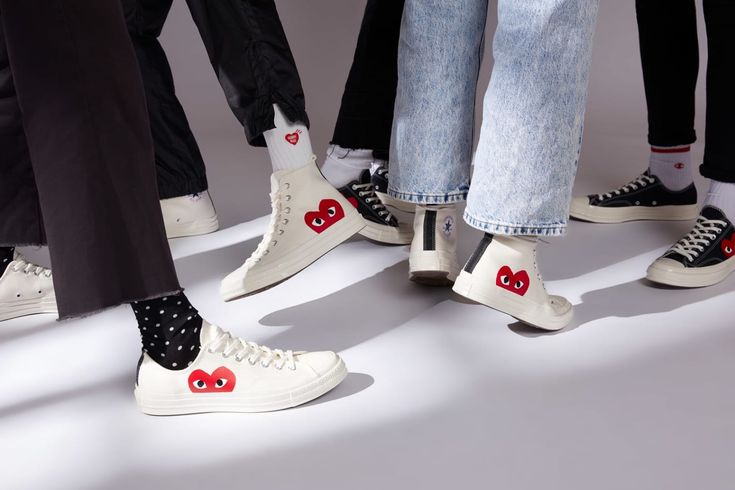
That red heart with eyes — designed by Filip Pagowski —
became one of fashion’s most recognizable symbols.
It wasn’t luxury; it was philosophy made wearable.
The simplicity was deceptive.
Each T-shirt carried Rei’s message:
imperfection, thought, wit, and irony.
Soon, PLAY x Converse sneakers flooded U.S. streets —
an emblem of creative contradiction:
rebellion meets innocence.
💥 5. DOVER STREET MARKET NEW YORK — A NEW TEMPLE OF CHAOS
Fast forward to 2013.
Rei Kawakubo and her husband, Adrian Joffe,
opened Dover Street Market New York on Lexington Avenue.
This was not a boutique.
It was a cathedral for ideas.
Each floor looked like an art installation —
sculptures, plywood walls, mirrors, noise, color, and tension.
You didn’t shop there; you experienced it.
The American retail world had never seen anything like it.
Fashion felt alive, unpredictable, cinematic.
Rei called it “beautiful chaos.”
And it was exactly that — an intersection of luxury and rebellion.
✧ 6. THE AMERICAN DESIGNERS WHO FOLLOWED
Rei Kawakubo didn’t just sell clothes in America —
she influenced its future thinkers.
You can trace her fingerprints on:
- Rick Owens — embracing the sculptural silhouette.
- Thom Browne — reimagining proportions.
- Virgil Abloh — turning conceptual thought into streetwear.
- Yohji Yamamoto and Issey Miyake — continuing the Japanese lineage of minimalism and chaos.
Even Kanye West’s Yeezy owes a nod to Rei’s visual philosophy —
a neutral palette, exaggerated shapes, dystopian emotion.
Comme des Garcons became the quiet blueprint
for how modern American fashion thinks about meaning.
✦ 7. COLLABORATIONS: WHERE LUXURY MEETS CULTURE
No one understood collaboration like Rei.
In the U.S., she partnered with brands that defined modern style:
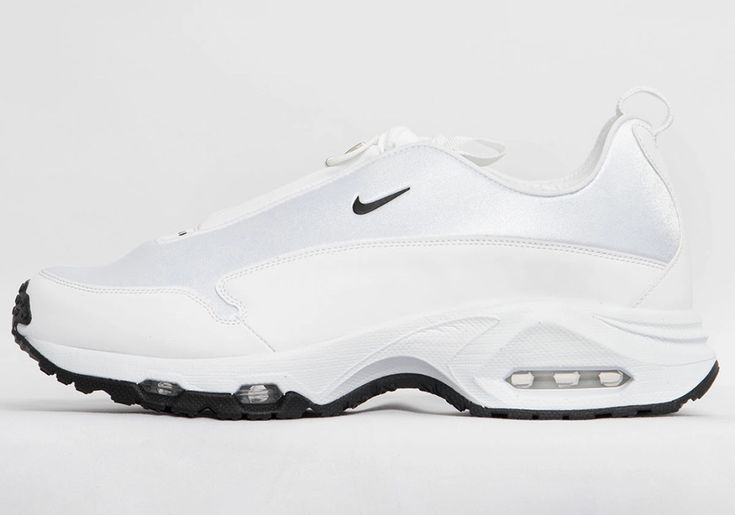
- Nike — reinventing sneakers as conceptual art.
- Supreme — merging skate culture with high design.
- Levi’s — the American denim re-coded through a Japanese mind.
- The North Face — performance wear turned into sculpture.
Each collab blurred borders: art, utility, philosophy, commerce.
Comme des Garcons taught American consumers
that collaboration could be an idea, not just a product.
✺ 8. FROM RUNWAY TO STREET: THE CULT STATUS
By the mid-2010s, Comme des Garcons had moved
from niche avant-garde to cultural iconography.
Celebrities wore it to red carpets;
students wore it to class.
You’d see the same heart logo
on both a fashion week runway and a Bronx skatepark wall.
That duality was the secret —
Rei never tried to be accessible, yet her ideas spoke universally.
The brand’s American success proved something rare:
that intellectual fashion could still thrive in a consumer world.
✧ 9. THE NEW GENERATION: AMERICA LEARNS TO THINK IN BLACK
Today, the Comme des Garcons ethos lives in a new wave of American creators.
You see it in:
- The genderless silhouettes of young New York designers.
- The art-school rebellion of Los Angeles streetwear.
- The DIY deconstruction trend sweeping Brooklyn and beyond.
Rei Kawakubo’s refusal to define beauty
has become a global permission slip —
especially for American youth,
who now use fashion to question identity, gender, and structure.
“When things become too normal, I change.” — Rei Kawakubo
That line became the American avant-garde mantra.
🌙 10. CULTURAL CROSSOVER: FASHION AS LANGUAGE
In Japan, Comme des Garcons was rebellion against tradition.
In America, it became rebellion against expectation.
The brand helped bridge two cultures:
Japan’s quiet depth and America’s loud experimentation.
It was proof that design could translate emotion without translation.
From runways in Paris to murals in Brooklyn,
from SoHo boutiques to skate parks in LA,
Comme des Garçons shaped how America sees itself in clothing.
💫 11. BEYOND CLOTHES — A PHILOSOPHY
Comme des Garçons in America was never just fashion;
it was an education in contradiction.
Minimalism that felt maximal.
Darkness that created light.
Clothing that refused to decorate.
Rei taught the U.S. fashion scene
that beauty doesn’t always attract —
sometimes, it disturbs.
And in that disturbance,
we find meaning.
❖ 12. LEGACY: THE REBELLION THAT NEVER ENDS
Decades later, the story still evolves.
Comme des Garçons continues to defy trends,
from pop-up markets to Met Gala sculptures.
You can feel its pulse in every American subculture
that values originality over perfection.
Rei’s empire of ideas expanded —
not through marketing,
but through mystery.
“What has meaning is not visible.” — Rei Kawakubo
✧ EPILOGUE ✧
Comme des Garçons didn’t conquer the USA —
it translated it.
From runway to street,
from SoHo to Supreme,
from art to attitude —
Rei Kawakubo turned fashion into philosophy,
and philosophy into everyday armor.
She gave America something it didn’t know it needed:
the beauty of being misunderstood.