TOKYO. 1970s.
A city of neon dreams, rising towers, and whispered revolutions.
In the backstreets of Shibuya and the silence of Aoyama’s studios, a designer began stitching a new language —
not of luxury, but of liberation.
Her name: Rei Kawakubo.
Her rebellion: Comme Des Garcons.
Her movement: beyond fashion.
🖤 CHAPTER I: THE ORIGIN STORY — TOKYO BEFORE THE STORM
Japan in the early 1970s was a world of paradoxes.
Postwar optimism had turned into capitalist rhythm — shiny department stores, pastel dresses, imported French ideals.
But under the surface, a new generation felt dissonance.
Artists, writers, photographers — all searching for authenticity in a city obsessed with progress.
It was here, between order and chaos, that Comme Des Garcons was born.
Rei Kawakubo didn’t come from a fashion school.
She studied fine art and literature at Keio University, where ideas mattered more than aesthetics.
After working as a stylist at Asahi Kasei, she realized something radical:
→ fashion could be thought, not just decoration.
1969 — she begins making her own clothes.
1973 — Comme Des Garcons officially becomes a brand.
A phrase lifted from a Françoise Hardy song: “Comme des garçons et des filles” — like boys and girls.
Except Rei’s vision was not “like boys.”
It was like no one before.
⚡ CHAPTER II: A LANGUAGE OF BLACK
Black wasn’t a color for Rei Kawakubo.
It was a statement. A scream in monochrome.
In the Tokyo of pink blouses and prim suits, black was anti-social — an act of cultural defiance.
When Comme Des Garcons embraced it, black became poetry.
“For something to be beautiful, it doesn’t have to be pretty.” — Rei Kawakubo
Her clothes were raw, asymmetric, and deliberately incomplete.
She left seams visible. Shapes unbalanced. Bodies redefined.
Each collection was like an unfinished sentence — forcing the viewer to finish it in their mind.
The Japanese press called it “dark” and “unfeminine.”
But young Tokyo rebels saw the truth:
It was freedom stitched into fabric.
🕶️ CHAPTER III: THE CROWS TAKE FLIGHT
By the late 1970s, Rei’s vision had created a tribe.
They were called The Crows — a cult of black-clad youth, roaming Aoyama and Harajuku in architectural silhouettes and emotionless faces.
They weren’t dressing up.
They were dressing down the idea of identity.
Their black clothes stood out in Japan’s uniform culture — and soon, the streets became living runways.
Fashion journalists began calling it “the Tokyo underground movement.”
Art. Rebellion. Mystery.
Comme Des Garcons was no longer just a label.
It was a mindset.
⚡ CHAPTER IV: THE AOYAMA EXPERIMENT
Aoyama — minimalist, modern, spiritual.
Here, Rei opened her first Comme Des Garcons store.
No decoration. No sound. No mirrors.
Just light, silence, and garments that hung like ideas in the air.
It wasn’t a boutique.
It was a manifesto in physical form.
Inside, clothes were displayed like artifacts — not sold as products.
Visitors felt like intruders in a holy space.
Rei didn’t want customers. She wanted believers.
This was retail reimagined — the seed of everything Comme would later become.
🖤 CHAPTER V: PARIS 1981 — THE WORLD SHOCKS
Paris Fashion Week, 1981.
The moment when Tokyo’s underground went global.
Models appeared — no makeup, no smiles, wrapped in asymmetrical black.
Music: silence.
The audience: stunned.
Fashion critics called it “Hiroshima Chic.”
They saw destruction.
But Rei saw rebirth.
It wasn’t about beauty anymore.
It was about the emotion behind it — the fragments, the void, the imperfection that made life real.
“I create from emotion, not demand.” — Rei Kawakubo
That show redefined fashion’s future.
Comme Des Garcons didn’t just join the Paris elite — it rewrote the rules they lived by.
⚔️ CHAPTER VI: DECONSTRUCTION BEFORE DECONSTRUCTION
Before Margiela, before Vetements — there was Rei.
She wasn’t breaking clothes apart.
She was breaking meaning apart.
→ Seams inside out
→ Shapes that fought anatomy
→ Jackets without shoulders
→ Dresses without symmetry
Her work wasn’t design — it was philosophy.
Critics called it “anti-fashion.”
But Rei never accepted that term.
She said:
“I’m not against fashion. I’m against definitions.”
And that is the essence of Comme Des Garcons — endless evolution.
✦ CHAPTER VII: THE 1980s EXPANSION — JAPAN TO THE WORLD
Back home in Tokyo, Comme Des Garcons became the uniform of intellectual rebellion.
The brand’s boutiques spread — Osaka, Kyoto, New York.
By the mid-1980s, Rei had built a global network of devotion.
Each store felt less like retail, more like theater.
Collections like Body Meets Dress, Dress Meets Body (1997) challenged the idea of perfection.
Padded lumps distorted silhouettes. The body became abstract.
At a time when Western designers sold glamour, Rei sold thought.
Her shows weren’t spectacles.
They were meditations.
🖤 CHAPTER VIII: THE 1990s — THE COMME UNIVERSE EXPANDS
The 1990s were Comme’s golden decade of experimentation.
Rei built an empire of sub-labels, each one exploring a different dimension of the same philosophy:
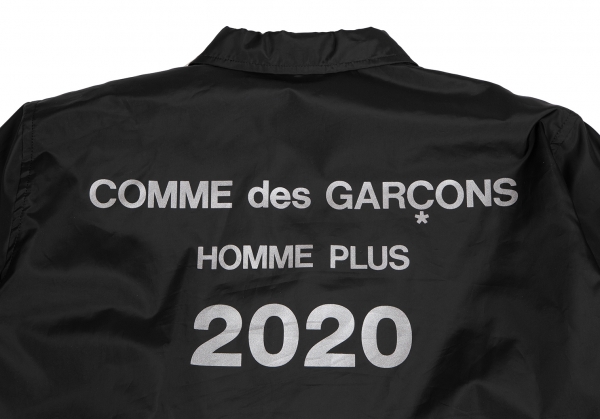
◆ Comme Des Garcons Homme Plus — redefining masculinity through art and construction.
◆ Comme Des Garcons Tricot — knitwear turned conceptual.
◆ Comme Des Garcons Noir — eternal elegance in black.
◆ Junya Watanabe Comme Des Garcons — her protégé blending technology, structure, and movement.
Each collection felt like a new language in fashion.
Meanwhile, Tokyo’s youth embraced Rei’s message of self-expression.
From Harajuku to Shinjuku, black and white became rebellion’s palette.
Street style in Tokyo — layered, oversized, genderless — was the direct descendant of Rei’s aesthetic.
💥 CHAPTER IX: THE 2000s — THE HEART GETS EYES
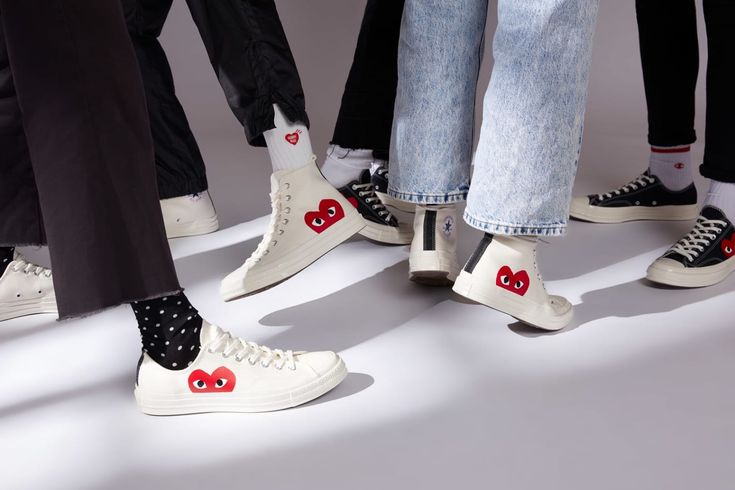
- A red, hand-drawn heart with curious eyes appeared.
The world met Comme Des Garcons PLAY.
It wasn’t luxury — it was love.
A softer, younger, more accessible version of the Comme universe.
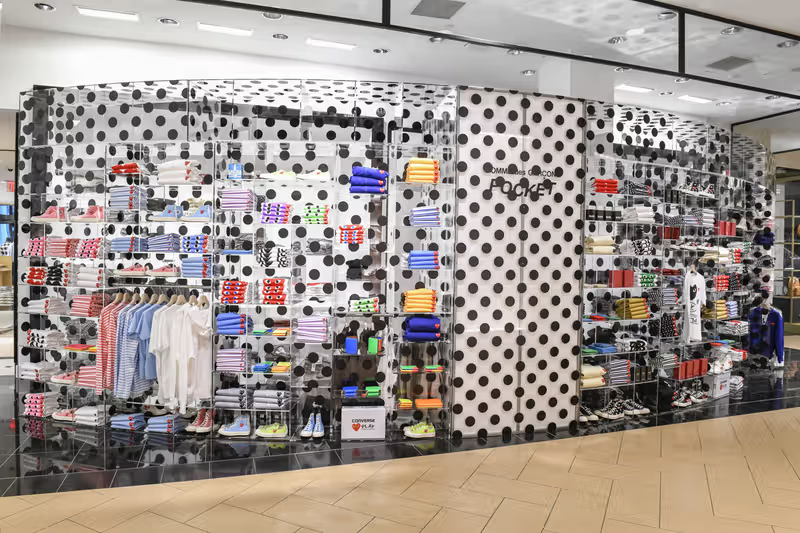
Collaborations with Converse, Nike, Supreme, and Bape followed.
Streetwear met philosophy.
PLAY wasn’t selling hype.
It was introducing Kawakubo’s values — imperfection, emotion, humanity — to a new generation.
“I work on many levels,” Rei said. “Some for the brain, some for the heart.”
That duality — intellect and instinct — became her signature.
⚡ CHAPTER X: DOVER STREET MARKET — CHAOS AS CURATION
Rei Kawakubo and her partner, Adrian Joffe, opened the first Dover Street Market in London, 2004.
It changed the definition of retail forever.
Each space was a living installation — curated chaos.
Art, fashion, and architecture collided.
Brands like Gucci, Raf Simons, and Palace stood side by side with Comme’s own lines.
No hierarchy. No rules.
Every store redesigned every season.
The message was clear:
Fashion is not product — it’s process.
🕊️ CHAPTER XI: 2010s — COMME AS ART
In the 2010s, Rei Kawakubo transcended fashion altogether.
Her runway shows became abstract performances.
- Not Making Clothes (2014) — garments that refused to be worn.
- White Drama (2012) — a meditation on life and death.
- The Future of Silhouette (2017) — sculpture as rebellion.
The Met Gala 2017 honored her with the exhibition “Rei Kawakubo / Art of the In-Between.”
Only one other living designer — Yves Saint Laurent — had received that recognition.
Inside, mannequins stood like spirits.
Fashion had become metaphysics.
“To be modern is to not be afraid.” — Rei Kawakubo
⚡ CHAPTER XII: TOKYO STILL BREATHES COMME
Tokyo’s underground may have evolved, but it never died.
Every alley in Harajuku, every window in Aoyama, every oversized coat on Omotesando —
they all whisper Comme Des Garcons.
From small indie designers to global icons, Rei’s fingerprints are everywhere:
◆ The genderless silhouettes of Rick Owens
◆ The raw seams of Margiela
◆ The conceptual minimalism of Yohji Yamamoto
◆ The poetic imperfection of Issey Miyake
Comme Des Garcons became the blueprint for creative independence.
🖤 CHAPTER XIII: REI KAWAKUBO — THE SILENT GODDESS
No Instagram. No interviews. No explanations.
Rei Kawakubo remains invisible — a ghost of genius behind the fabric.
Her power lies in absence.
Designers chase trends.
Rei chases the unknown.
She doesn’t follow fashion cycles.
She creates her own time zone.
“The only way to be new is to be alone.” — Rei Kawakubo
Every season, she reinvents the wheel — only to break it again.
Comme Des Garcons isn’t a brand; it’s a continuing question.
⚔️ CHAPTER XIV: THE LEGACY — FROM UNDERGROUND TO ICON
The legacy of Comme Des Garcons isn’t measured in sales or stores.
It’s measured in ideas — the courage to think differently.
From Tokyo’s 1970s rebellion to today’s metaverse runways, Rei Kawakubo’s influence has become a global current.
Every asymmetric hem, every gender-fluid form, every designer who asks “Why?” — they owe her a debt.
The Tokyo underground gave birth to an empire of thought.
And Rei Kawakubo turned black into infinity.