The Avant-Garde Manifesto of Rei Kawakubo
[ 0 ] — The Black Code Begins
Tokyo.
1969.
A woman holds scissors, not as a tool — but as a rebellion.
Rei Kawakubo.
No formal training.
No permission.
Only intention.
She cuts through fabric like she’s cutting through ideology.
Fashion, she decides, will not decorate. It will disrupt.
Her new world needs a name.
A paradox. A poem. A French echo in Japanese silence.
She writes it in lowercase letters:
comme des garçons — like boys.
Not a brand. A code.
Not style. A stance.
A whisper that would grow into a roar from Japan to France.
[ 1 ] — Tokyo Before the Storm
The 1970s hum.
Salarymen swarm. Neon blinks. The city breathes routine.
But in a small studio near Aoyama, something else is forming.
Black on black.
Threads that defy.
Bodies dressed in philosophy.
She begins quietly.
Her collections are like meditations: asymmetry, imperfection, the grace of destruction.
Her models move like ghosts — serene, radical.
The Tokyo boutiques become temples for the disenchanted.
Students, thinkers, rebels — they gather under her black sun.
Comme des Garçons isn’t about fashion anymore.
It’s a movement. A mirror. A question mark sewn into every sleeve.
[ 2 ] — The Jump to Paris
- Paris.
The air smells of perfume and power.
Then — silence.
Lights dim.
The first model steps out.
The audience gasps.
Black. Torn. Unfinished.
Shapes collapsing and blooming all at once.
Shoulders hunched, threads visible, fabric burned.
Critics whisper: “Hiroshima chic.”
The old guard sneers.
But art critics weep.
Because something real just entered the room.
Something unpolished, unapologetic, human.
From Japan to France, Rei Kawakubo has arrived — not to belong, but to break.
[ 3 ] — The 1980s: Era of Disassembly
This is the decade of deconstruction.
The years of raw truth.
The birth of anti-fashion.
Kawakubo and her peers — Yohji Yamamoto, Issey Miyake — rewrite what beauty means.
The West calls it “ugly.”
They call it freedom.
Each collection is a manifesto:
| Year | Title | Vision |
|---|---|---|
| 1982 | “Destroy” | Beauty in chaos. Seams exposed. Truth unstitched. |
| 1983 | “Body Meets Dress, Dress Meets Body” | Padded distortions. The human form reimagined. |
| 1986 | “Homme Plus” | Menswear becomes emotion. Tailoring undone. |
Kawakubo isn’t making clothes — she’s making questions.
Can you wear discomfort?
Can fabric speak pain?
Can imperfection be divine?
Every answer: yes.
[ 4 ] — 1990s: Expansion, Explosion, Essence
Her black empire grows.
Not by replication — but mutation.
Comme des Garçons Parfum — launched 1992.
Scent of smoke. Tar. Dust. Memory.
Perfume that smells like thought.
Junya Watanabe — launched 1994.
Her disciple. Her mirror.
Engineering meets emotion.
Tricot Comme des Garçons. Homme Deux. Shirt. Wallet.
Each line, a new philosophy.
Each garment, an essay.
Her quote becomes scripture:
“The only way to make something new is to destroy the old.”
While others chase seasons, she chases meaning.
Her collections feel less like fashion — more like haiku.
Minimal. Violent. Perfectly imperfect.
[ 5 ] — The 2000s: Heart, Market, Chaos
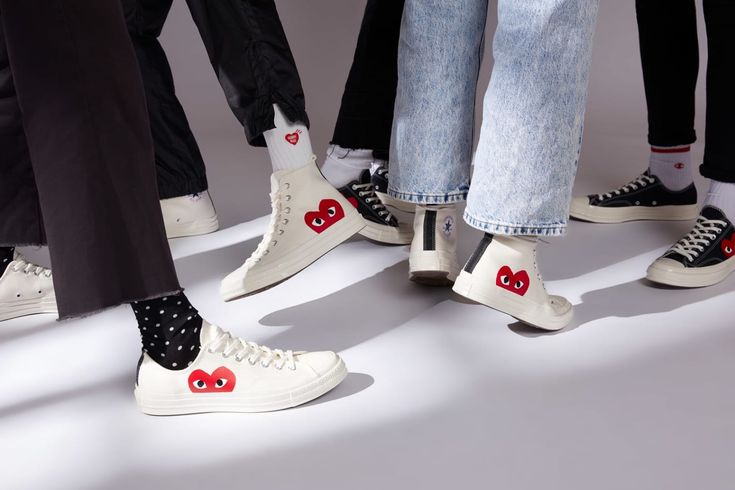
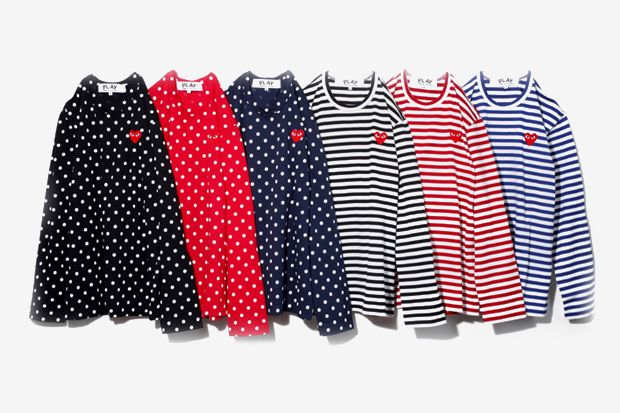
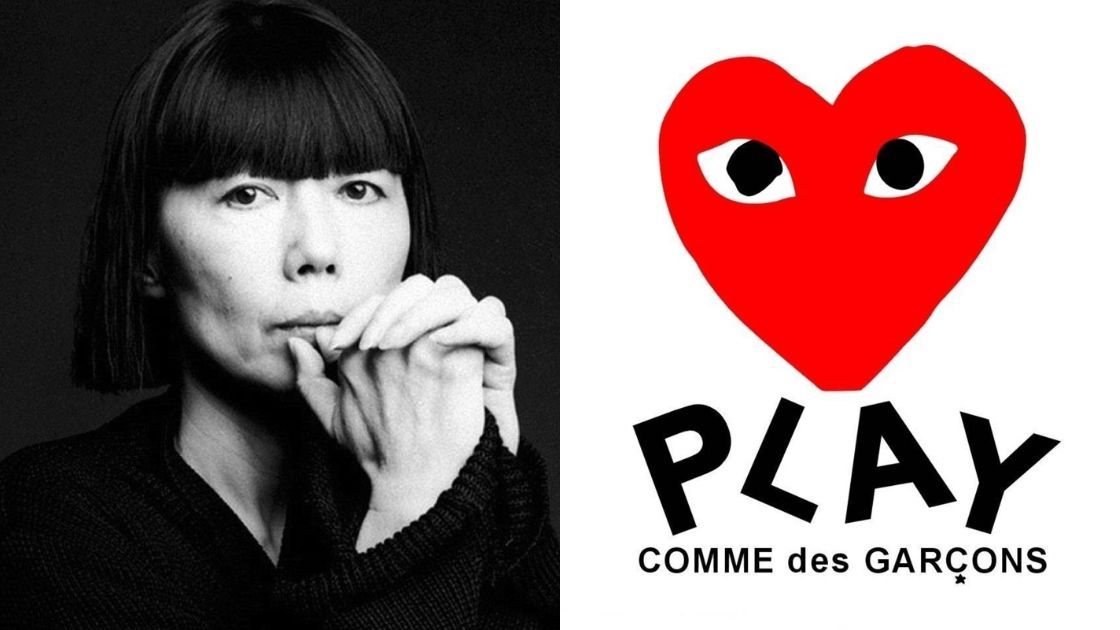
A red heart blinks into existence.
Two eyes stare through you.
Comme des Garçons PLAY — 2002.
Designed by Filip Pagowski.
A symbol of irony and intimacy.
It spreads like wildfire.
From Shibuya to New York, everyone wears rebellion disguised as simplicity.
But Rei doesn’t stop.
She builds the Dover Street Market (London, 2004).
Not a store.
A living organism.
Concrete, steel, and soul.
Each floor, a new universe.
Fashion meets installation art.
Commerce meets consciousness.
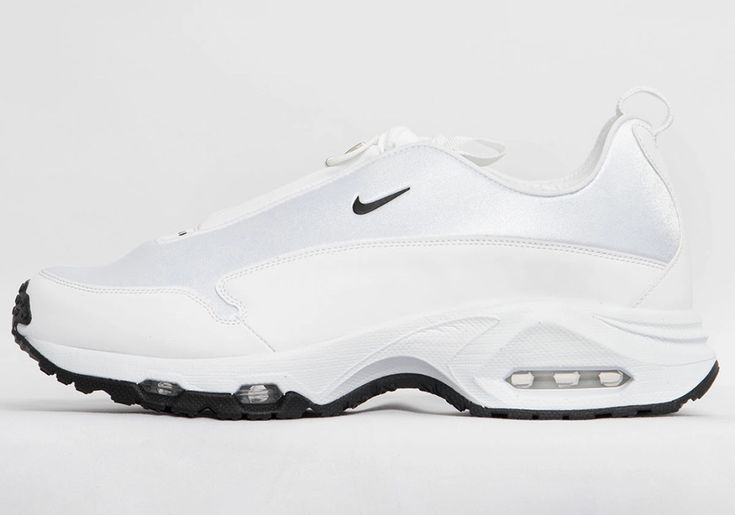
Collabs multiply —
Nike, Converse, Supreme, Louis Vuitton, H&M.
But none dilute her truth.
Because Kawakubo never follows — she absorbs, transforms, redefines.
“Collaboration is evolution, not compromise.”
[ 6 ] — The 2010s: The Age of Emotion
Fashion becomes theater.
Runways become philosophy labs.
2012 — White Drama —
Rituals of life and death in white cocooned shapes.
2014 — Not Making Clothes —
A declaration: function is no longer required.
2017 — The Met Exhibition: Art of the In-Between —
Rei Kawakubo becomes the second living designer ever honored by The Met.
Her work displayed like architecture of the soul.
She has transcended the industry.
She’s no longer designing for people — she’s designing about people.
[ 7 ] — 2020s: The Algorithm Meets the Soul
The world fractures.
Fashion goes digital, disposable, dopamine-driven.
But Rei Kawakubo continues her quiet resistance.
| Year | Collection | Theme |
|---|---|---|
| 2020 | “Neo Future” | The solitude of the screen age. |
| 2021 | Homme Plus “Metal Outlaw” | Futurist punk — steel and softness. |
| 2023 | “Black Rose” | Strength through fragility. |
| 2024 | “In-Between Worlds” | Harmony born from contradiction. |
Her shows are no longer linear.
They’re symphonies — emotion, architecture, and silence colliding.
While others chase the next, she still explores the why.
[ 8 ] — The Philosophy of the Unfinished
Comme des Garçons is not fashion.
It’s a state of mind — suspended between extremes.
╭─────────────────────────────────────╮
│  Deconstruction → destroys form     │
│  Androgyny → dissolves boundaries   │
│  Imperfection → reveals humanity    │
│  Freedom → transcends fear          │
╰─────────────────────────────────────╯
Kawakubo designs like a philosopher trapped inside a tailor’s body.
Each seam is a sentence.
Each fold, a thought experiment.
She redefines the word clothing — turning it into a medium for existential art.
“I never wanted to fit in. I wanted to stand for something.”
And stand she does — between Japan’s subtlety and France’s expression, balancing void and vision.
[ 9 ] — The Axis of Cultures
The name Comme des Garçons itself is the bridge — a Japanese idea, spoken in French.
It embodies contradiction.
| Element | Japan | France |
|---|---|---|
| Spirit | Wabi-sabi — imperfection | Haute couture — precision |
| Emotion | Restraint | Extravagance |
| Outcome | Harmony in opposition |
In Rei’s world, contrasts don’t collide — they converse.
The Japanese void embraces the French flourish.
The result is a dialogue stitched in black thread.
From Tokyo’s discipline to Paris’s drama, Kawakubo proves that identity is not singular — it’s spectral.
[ 10 ] — Rei Kawakubo Herself
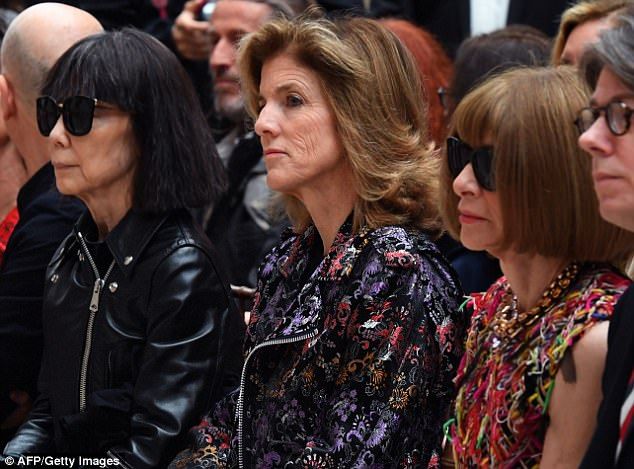
She doesn’t smile for cameras.
She doesn’t explain her shows.
She doesn’t need to.
Her silence is louder than statements.
Her hair — geometric, symbolic.
Her eyes — focused on the invisible.
Adrian Joffe, her husband and business partner, calls her “a thinker who happens to make clothes.”
She works in her Tokyo studio surrounded by chaos — scissors, fabric, instinct.
No sketches. No digital mockups.
Just intuition — pure and precise.
The industry calls her mysterious.
But really, she’s just free.
[ 11 ] — The Legacy That Refuses to End
Fifty years of Comme des Garçons.
Fifty years of redefining everything.
From Japan to France, from avant-garde to mainstream, from couture to street.
And yet — still original. Still unpredictable. Still unrepeatable.
Her influence echoes through Rick Owens, Martin Margiela, Demna Gvasalia, Virgil Abloh —
all children of her chaos.
They learned what she taught:
That fashion is not surface — it’s substance.
That style is not decoration — it’s declaration.
╔══════════════════════════════════╗
║ “I don’t create for acceptance.  ║
║  I create for evolution.”        ║
║     — Rei Kawakubo               ║
╚══════════════════════════════════╝
[ 12 ] — The Future She Built
What happens next?
AI art. Metaverse fashion. Algorithmic trends.
But Kawakubo predicted all this long ago.
She saw the collision of body and data before it happened.
Her “Body Meets Dress” collection was an early digital dream — distortions, simulations, avatars.
Even now, her pieces feel post-human —
Garments as architecture.
Clothing as code.
The future will wear Comme des Garçons — not because it’s trendy, but because it’s timeless.
[ 13 ] — The Final Manifesto
COMME DES GARÇONS IS NOT CLOTHING.
It is architecture of emotion.
It is rebellion sewn in silence.
It is Japan whispering in French.
It is the shadow that teaches light what beauty means.
Every thread is an argument.
Every cut, a confession.
Every black dress, a declaration of self.
Rei Kawakubo gave us not garments — but vocabulary.
A new syntax for style.
A new grammar of imperfection.
And the world will keep trying to imitate her.
But the truth is — she is not of this time.
She is time.